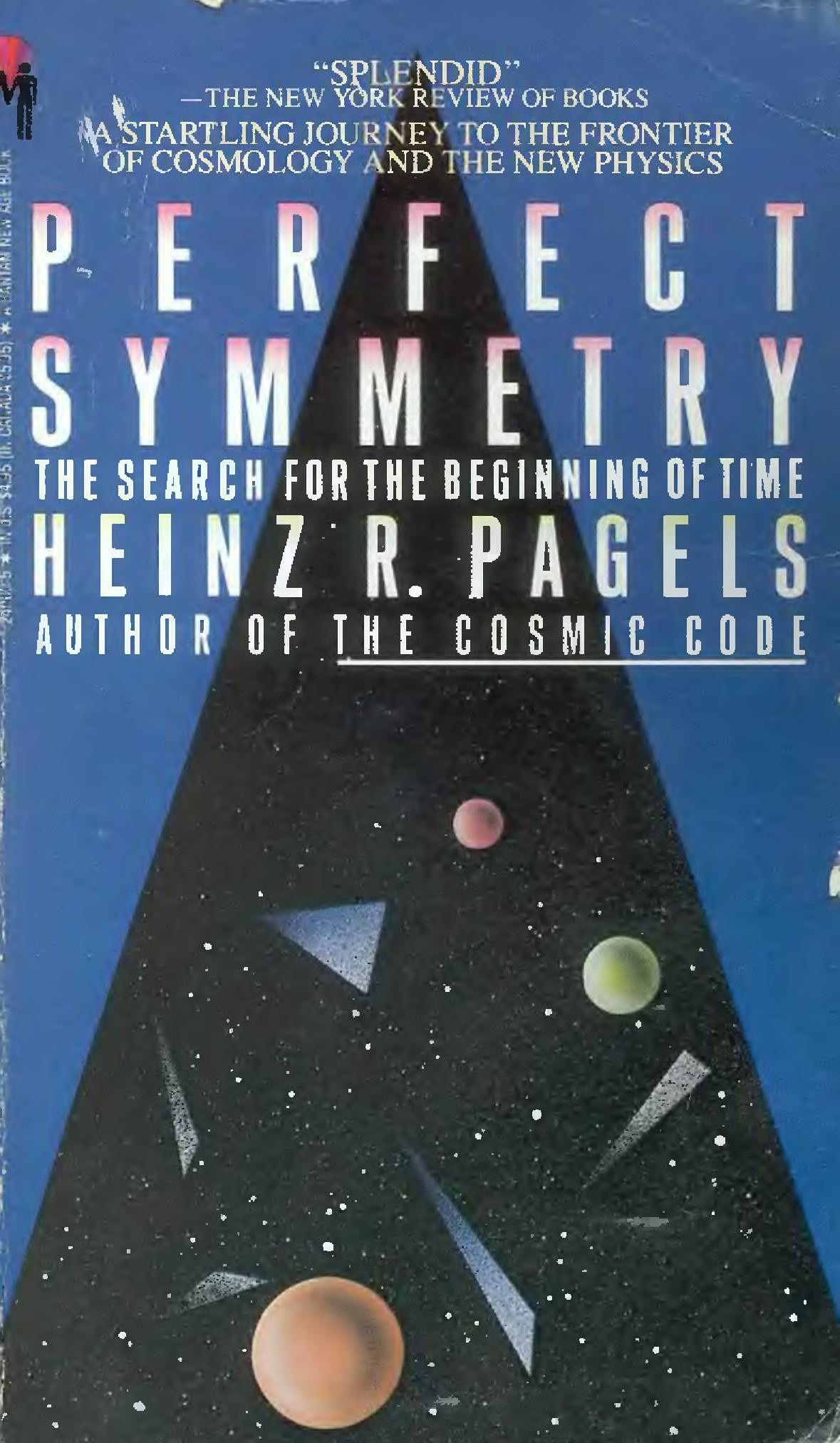
"Perfect Symmetry" by Heinz Pagels embarks on an ambitious intellectual journey to unravel humanity's quest for understanding the universe's absolute beginning. The book delves into the revolutionary advances in particle physics and cosmology that sought to explain the fundamental constituents of matter and the forces that govern them, from the fleeting moments after the Big Bang. Pagels guides the reader through the intricate landscape of quantum field theory and the Standard Model, explaining how scientists grappled with forces like electromagnetism and the weak nuclear force, aiming to find elegant, unifying principles that dictate cosmic evolution.
The narrative centers not on fictional characters but on the real-life pioneers whose brilliant insights and sometimes contentious debates shaped our modern scientific worldview. Figures like Sheldon Glashow, Steven Weinberg, Abdus Salam, and Murray Gell-Mann are brought to life through their theoretical contributions, illustrating the collaborative and competitive spirit inherent in groundbreaking research. Pagels explores profound themes of symmetry in nature, the breakdown of fundamental symmetries in the early universe, and the philosophical implications of these discoveries, questioning our place in a cosmos born from such extreme conditions. What makes the book compelling is its ability to translate highly abstract physics into an accessible, dramatic saga of human curiosity and intellectual daring, revealing the awe-inspiring beauty and profound mystery at the heart of existence.